
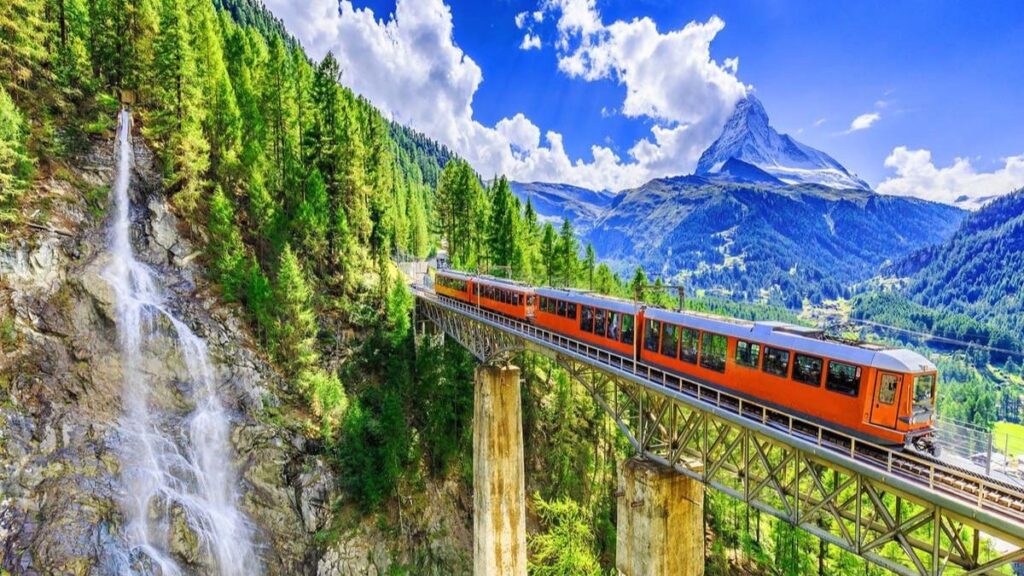
Train journeys have a way of slowing the world down. Unlike planes or highways that rush travelers from one place to another, trains allow the landscape to unfold gradually outside the window. Every turn of the railway brings a fresh view.
Some railway routes are especially remarkable because they travel through extreme terrain where building tracks required bold engineering and creative problem-solving. Over the years, these railways have become attractions in their own right.
Travelers board them not just to reach a destination. But to experience the scenery, history, and sense of adventure that only a slow journey on rails can provide.
The Jungfrau Railway, Switzerland
Some train journeys offer beautiful scenery. The ride on the Jungfrau Railway feels like entering an entirely different world.
The railway climbs to Jungfraujoch, famously known as the “Top of Europe,” where the station sits about 3,454 metres above sea level. Step off the train and the atmosphere changes instantly. Icy air brushes your face, snow crunches beneath your feet, and the surrounding peaks make it clear you are standing deep in the high Alps.
The train journey itself is an engineering spectacle. After leaving Kleine Scheidegg, the line travels through tunnels carved into the Eiger and Mönch mountains. It’s a bold early-20th-century project that took more than a decade to complete. Along the way, passengers glimpse glaciers and steep Alpine cliffs before emerging at the summit.
But the real magic begins once you arrive. Jungfraujoch lies within the Jungfrau-Aletsch UNESCO World Heritage region. Dramatic 4,000-metre Alpine peaks surround the area and overlook the Aletsch Glacier, the longest glacier in the Alps.
Visitors can explore the Ice Palace carved inside the glacier. They can also learn the railway’s story at the Alpine Sensation multimedia exhibition or enjoy sweeping views from the Sphinx Observatory.
Standing there, with glaciers stretching to the horizon, the journey truly feels like a once-in-a-lifetime experience.
The Pikes Peak Cog Railway, Colorado Springs
In North America, the crown for high-altitude rail travel belongs to the Pikes Peak Cog Railway. The historic train climbs Pikes Peak in Colorado, rising to more than 14,000 feet above sea level. This makes it the highest cog railway in the United States.
The nine-mile ride begins near Colorado Springs and soon enters the wilderness of Pike National Forest. In autumn, aspens and Rocky Mountain maples glow gold and red against deep green pines. Among them stand ancient bristlecone pines, some over 2,000 years old.
Soon, the train passes Ruxton Creek and begins the steep ascent through Engelmann Canyon. Wildlife sightings are common along the route. Travelers often spot elk, deer, yellow-bellied marmots, and even bighorn sheep on the mountain slopes.
At the summit, visitors can step off to explore the visitor center and admire sweeping views across the Rocky Mountains. Some adventurous travelers even choose to descend via the 13-mile Barr Trail.
If you’re driving to the railway, it’s worth taking things slowly. A 2025 TRIP report found that 28% of major roads in Colorado Springs are in poor condition, so extra caution helps. Even though most trips are safe, unfamiliar mountain roads can still lead to accidents, as Springs Law Group notes.
In those situations, speaking with a car accident attorney in Colorado Springs can help you understand your options. They can guide you through insurance claims and handle the legal details so you can focus on recovering.
The Darjeeling Himalayan Railway, India
The Darjeeling Himalayan Railway, often called the Toy Train, is more than a scenic ride through the hills. It is a living piece of history that has shaped life in the eastern Himalayas for over a century.
In the late nineteenth century, transporting goods between Siliguri in the plains and the hill town of Darjeeling was slow and expensive. Everyday essentials like rice and potatoes cost far more in the mountains because everything had to be hauled along a single steep road. To solve this problem, British administrators proposed a steam railway that could move goods and passengers more efficiently.
The idea also served another purpose. A railway would support the rapidly growing Darjeeling tea industry, making it easier to transport tea leaves down to markets.
Locomotives were shipped from Manchester in England, and in 1881, the narrow two-foot gauge railway officially opened. The small steam train soon began its remarkable climb through the Himalayan foothills, weaving past villages, forests, and tea gardens.
More than a century later, the railway remains one of the region’s most beloved and distinctive landmarks.
The Flåm Railway, Norway
Few rail journeys pack as much scenery into such a short distance as the Flåm Railway in Norway. It’s often described as one of the most beautiful train rides in the world, as reported by The Mirror. The route connects the small fjord village of Flåm with the mountain station of Myrdal high above the valley.
The journey covers just about 20 kilometres, yet the train climbs from the edge of the Aurlandsfjord up into dramatic mountain terrain. Along the way, the landscape shifts constantly. Green valleys open below the tracks, rivers rush through deep gorges, and waterfalls spill down steep cliffs beside the railway.
The route is famous for its extraordinary engineering. To handle the steep mountainsides, the line passes through twenty tunnels, many of which were carved directly into the rock by hand. As the train winds higher, passengers are treated to sweeping views of farms clinging to hillsides and tiny villages scattered across the valley floor.
One of the most memorable stops occurs near the powerful Kjosfossen waterfall. The train pauses so travellers can step outside and watch the roaring cascade crash down the mountainside, often accompanied by drifting mist.
Despite the dramatic setting, the ride itself feels calm and unhurried. By the time the train reaches Myrdal, the journey feels like a moving window into Norway’s rugged landscape.
FAQs
Which is the highest railway station in the world?
The world’s highest railway station is Tanggula railway station, located in Tibet, China. It sits about 5,068 meters above sea level on the Qinghai–Tibet Railway. The station opened in 2006 and stands in a remote, high-altitude region of the Tibetan Plateau.
What is a cog rail system?
A cog rail system is a railway designed for steep mountain slopes. It uses a toothed rack rail between tracks and a cogwheel on the train for extra grip. This system allows trains to climb gradients that normal railways cannot safely manage.
What is Europe’s most luxurious train ride?
One of the most luxurious train journeys in Europe is the Venice Simplon-Orient-Express. This historic train features elegant cabins, gourmet dining, and classic 1920s style. It travels through iconic cities and landscapes across Europe, offering a timeless luxury rail experience.
These remarkable railways remind us that travel does not always have to be fast to be meaningful. When a journey slows down, the experience becomes richer. Passengers notice the changing landscapes, the sounds of the train, and the quiet beauty of places that might otherwise pass unnoticed.
Many of these routes were originally built to solve practical challenges, yet they have become treasured travel experiences over time. Today, they continue to carry visitors through landscapes that are both dramatic and fragile.